
By: The Trek News Desk
A recently released White Paper by the Tamil Nadu government has brought attention to growing concerns over the state’s fiscal health, highlighting a noticeable decline in its tax revenue generation over the past few years. The report suggests that Tamil Nadu’s ability to mobilise its own tax resources has weakened, raising questions about revenue management and long-term financial sustainability.
Presented in the State Assembly by Finance Minister N. Wilson, the document compares Tamil Nadu’s revenue performance with that of benchmark states such as Maharashtra, Gujarat, and Karnataka. According to the findings, Tamil Nadu has underperformed relative to these states in key tax collection indicators.
The White Paper notes that the State Own Tax Revenue (SOTR) as a percentage of Gross State Domestic Product (GSDP) fell from 5.93 per cent in 2021-22 to 5.45 per cent in 2025-26. The decline places Tamil Nadu among the weaker performers in terms of revenue mobilisation during the post-pandemic period.
While Maharashtra reportedly improved its tax-to-GSDP ratio and Karnataka and Gujarat managed to maintain relatively stable levels, Tamil Nadu was the only state among the comparison group to register a noticeable drop during the same period.
Tamil Nadu’s tax collections are largely derived from Goods and Services Tax (GST), value-added tax on petroleum products, excise duties and taxes on liquor, stamp and registration fees, and motor vehicle taxes.
The report highlights that commercial tax collections as a share of GSDP declined from approximately 4.53 per cent in 2021-22 to 3.89 per cent in 2025-26. Such a trend was not observed in the peer states reviewed in the report.
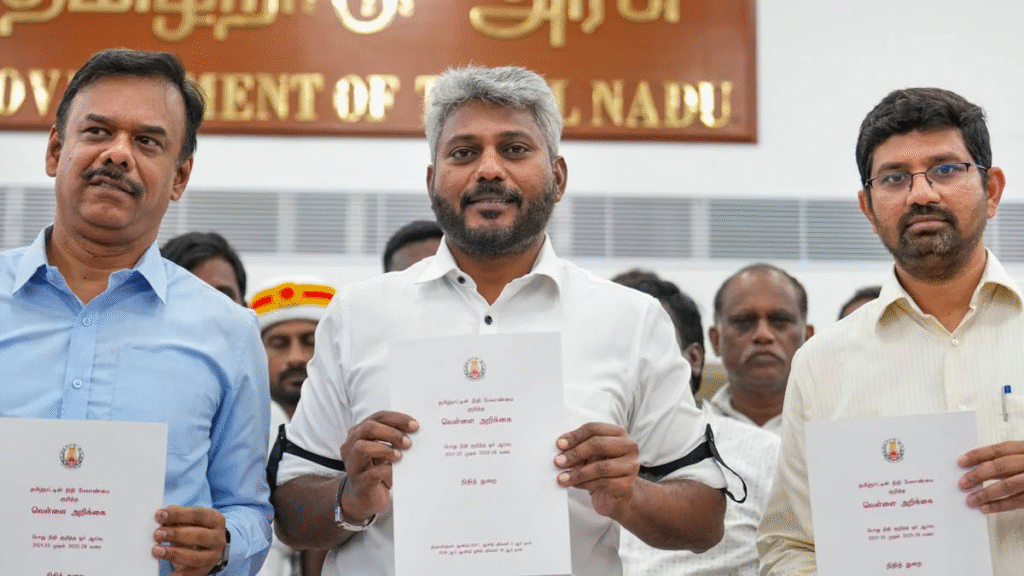
According to the White Paper, the decline cannot be attributed solely to economic conditions. The document points to revenue leakages, administrative inefficiencies, and possible irregularities within revenue-generating departments as factors that may have contributed to the reduced tax performance.
The report indicates that several major revenue streams, including GST, petroleum VAT, excise duties, stamp duties, and motor vehicle taxes, have experienced downward trends over the review period.
A major concern highlighted in the report is the increasing share of tax revenue being used to service existing debt. The proportion of state tax collections spent on interest payments rose from 33.83 per cent in 2021-22 to 34.83 per cent in 2025-26.
This means that more than one-third of every rupee collected through the state’s taxation system is being directed toward meeting interest obligations on past borrowings, leaving fewer resources available for public spending.
The findings of the White Paper have sparked fresh discussions regarding Tamil Nadu’s fiscal policies and revenue administration. Experts warn that if tax collection efficiency is not strengthened, the state could face increasing pressure on its finances, potentially affecting economic growth and public investment plans.
As policymakers assess the report’s conclusions, improving revenue collection mechanisms, reducing leakages, and enhancing financial governance are likely to become key priorities for ensuring long-term fiscal stability in Tamil Nadu.
Source: News Agencies