By: The Trek News Desk
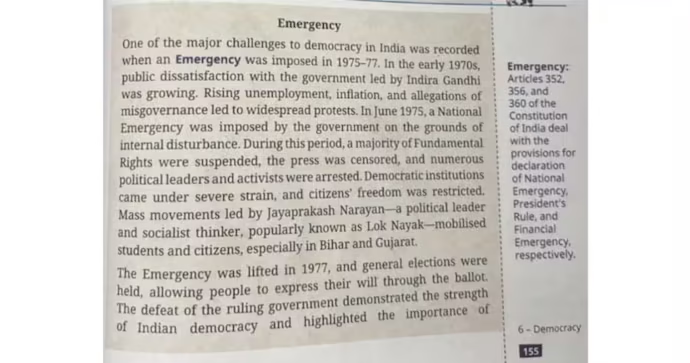
The National Council of Educational Research and Training (NCERT) has, for the first time, introduced a dedicated chapter on the Emergency in the Class 9 Social Science curriculum. The topic is presented as a major and critical challenge faced by Indian democracy.
The subject has been included in the newly published textbook Understanding Society: India and Beyond, which explores both the strengths of democratic systems and the challenges they encounter. The revision comes at a time when India marks 50 years since the imposition of the Emergency in 1975.
The textbook describes the period between 1975 and 1977 as one of the most sensitive phases in India’s democratic history. It notes that during this time, fundamental rights were suspended, press freedom was curtailed, and several political leaders, as well as social activists, were detained.
According to the content, democratic institutions came under significant pressure, and governance structures were deeply impacted throughout the Emergency period.
The curriculum also explains that widespread dissatisfaction had been building in the early 1970s due to issues such as rising unemployment, inflation, and administrative irregularities. This led to large-scale protests across different parts of the country.
In June 1975, a National Emergency was declared, citing “internal disturbance,” a decision that is presented as a turning point in India’s constitutional and political history.
The textbook includes references to the mass political movement led by social and political leader Jayaprakash Narayan. Student-led protests in states such as Bihar and Gujarat played a significant role in shaping the political climate of that period.
The end of the Emergency in 1977 and the subsequent general elections are described as a strong reaffirmation of India’s democratic framework.
The revised syllabus places the Emergency within a wider discussion on challenges faced by democracy, including misinformation, poverty, regionalism, social inequality, and violations of civic responsibilities.
It also introduces a new chapter titled “Democracy and You,” aimed at helping students understand their role as active citizens in a democratic society.
The updated content highlights India’s democratic institutions and traditions, referring to the media as the “fourth pillar of democracy.” It also includes data and insights related to the country’s electoral system and voter participation.
Additionally, case studies from local governance models in Gujarat and Tripura are included to demonstrate grassroots democracy and citizen participation at the village level.
Source: News Agencies