

By: The Trek News Desk
As winter sets in across northern India, toxic haze once again blankets major cities. The term “AQI”, Air Quality Index, dominates headlines, social media, and public concern. But what exactly is AQI, how is it calculated, and what does it really mean for our health? Let’s break it down.
What is AQI?
The Air Quality Index (AQI) is a standardised system that converts complex air pollution data into a single, easy-to-understand number, helping citizens gauge whether the air they breathe is “good,” “poor,” or dangerously “severe.”
In India, the AQI is monitored and published by the Central Pollution Control Board (CPCB). Data from hundreds of air monitoring stations nationwide is processed daily to assess the quality of ambient air.
How the AQI is Calculated
The AQI is determined based on the concentration levels of six major air pollutants:
- PM2.5 – fine particles that can penetrate deep into the lungs
- PM10 – coarse dust particles suspended in the air
- Nitrogen Dioxide (NO₂) – emitted mainly from vehicles and industry
- Sulphur Dioxide (SO₂) – produced by burning fossil fuels
- Carbon Monoxide (CO) – a colourless, odourless gas from incomplete combustion
- Ozone (O₃) – a secondary pollutant formed when sunlight reacts with other gases
Each pollutant’s 24-hour average concentration is measured, and the one posing the greatest risk decides the day’s final AQI score.
AQI Categories and What They Mean
| Category | AQI Range | Health Impact |
| Good | 0 – 50 | No adverse effects |
| Satisfactory | 51 – 100 | Generally acceptable air quality |
| Moderate | 101 – 200 | Minor irritation for sensitive groups |
| Poor | 201 – 300 | Breathing discomfort, eye irritation |
| Very Poor | 301 – 400 | Health effects for everyone |
| Severe | 401 – 500+ | Dangerous for all; long-term exposure is life-threatening |
How Toxic Air Impacts Health
Prolonged exposure to polluted air affects nearly every system in the human body:
- Lung capacity decreases, especially among children and the elderly.
- Higher risk of asthma, stroke, and heart disease.
- Skin and eye irritation become common.
- Pregnant women face increased risks to fetal development.
According to the World Health Organisation (WHO), air pollution contributes to over one million premature deaths annually in India, making it one of the country’s deadliest environmental hazards.

India’s Most Polluted Cities
Recent 2025 reports place Delhi once again at the top of India’s most polluted cities. Others like Ghaziabad, Bhiwadi, Faridabad, Lucknow, and Noida continue to remain in the “very poor” or “severe” category for most of the winter.
The main culprits? Crop residue burning, vehicle emissions, industrial discharge, and construction dust all combine under stagnant winter air to create toxic smog.
Cities with the Cleanest Air
Despite grim statistics, a few Indian cities continue to breathe easier.
Mysuru (Karnataka), Kottayam (Kerala), Shillong (Meghalaya), and Amravati (Maharashtra) frequently record AQI levels below 50.
Lush green cover, limited industrial activity, and reduced traffic congestion help keep their air comparatively clean.
The Global Picture
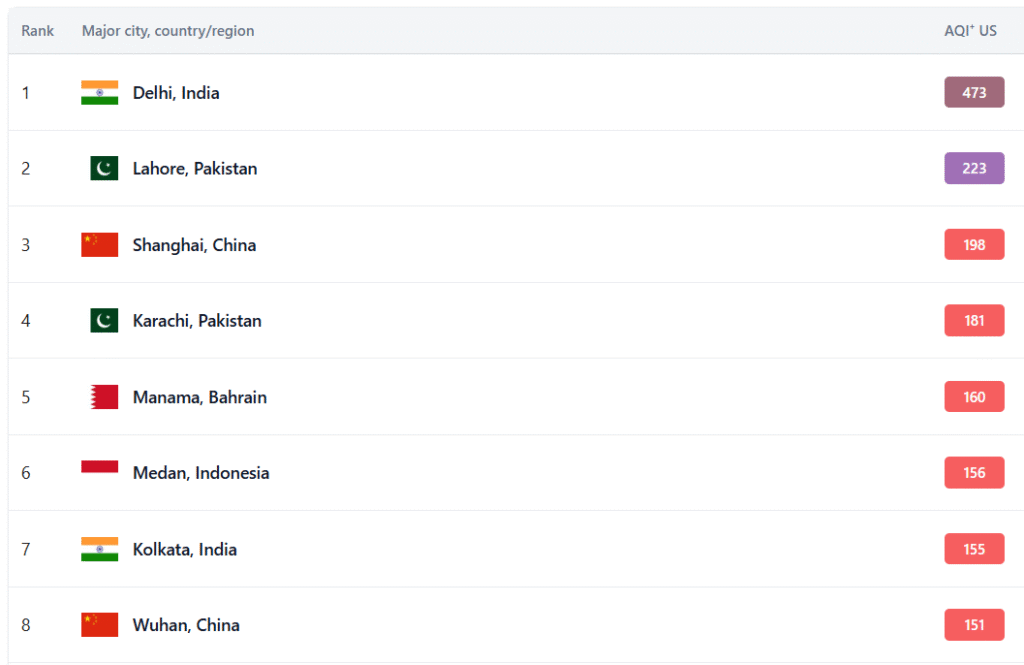
Globally, Lahore (Pakistan) and Dhaka (Bangladesh) are currently among the world’s most polluted cities, while Helsinki (Finland) and Oslo (Norway) often top lists of the cleanest air.
(Note: These rankings fluctuate based on real-time global air quality data.)

The Way Forward
Combating air pollution requires action not just from governments but from every citizen.
- Encourage public transport and the shift to electric mobility.
- Enforce dust control at construction sites.
- Crack down on stubble and garbage burning.
- Expand urban green belts and tree cover.
- Use masks, air purifiers, and indoor plants to reduce exposure.
The Bottom Line
AQI isn’t just a number; it’s the health report card of our lungs.
If we ignore it today, tomorrow’s air could become unbreathable. Clean air is no longer a privilege; it’s a fundamental right that now demands collective responsibility.
Source: News Agencies

