
By: The Trek News Desk
In a significant development for regional air connectivity and bilateral relations, India and China are set to resume direct flight services later this month, nearly five years after the routes were suspended in 2020 during the peak of the COVID-19 pandemic. The move is being seen as a step towards normalizing ties and easing travel between the two Asian giants.
According to a statement from the Ministry of External Affairs (MEA) on Thursday, direct flights connecting specific cities in India and China can begin by the 26th of October, depending on the commercial readiness of the designated airlines and fulfillment of all operational requirements.
Flights were halted due to COVID and border tensions
Direct air services between India and China were halted in early 2020 when the COVID-19 pandemic triggered a global aviation shutdown. However, even after international flights resumed elsewhere, India-China routes remained closed largely due to ongoing border tensions in eastern Ladakh, which led to a diplomatic freeze on multiple fronts.
Technical discussions laid the groundwork
Earlier this year, civil aviation authorities from both sides held technical-level discussions to explore the revival of direct flights and amendments to the Air Services Agreement. These talks laid the groundwork for the long-awaited restart.
IndiGo takes the lead with Kolkata–Guangzhou flights
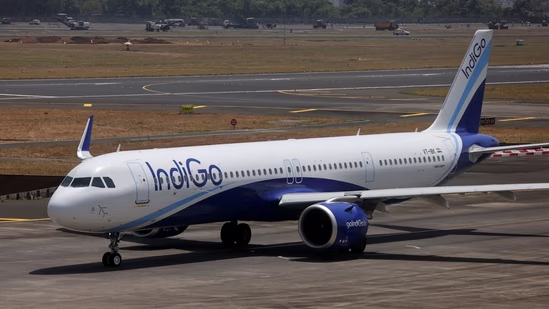
Leading Indian carrier IndiGo has already announced its first China-bound route under the new arrangement. Starting October 26, the airline will begin non-stop daily flights between Kolkata and Guangzhou. Additionally, IndiGo is eyeing a Delhi–Guangzhou direct route, pending final regulatory approvals.
Diplomacy played a key role
The resumption of air services was also a key agenda point in high-level diplomatic interactions earlier this year. During his January visit to China, Indian Foreign Secretary Vikram Misri discussed the issue with Chinese officials, leading to an “in-principle” agreement to restore direct connectivity. This was reaffirmed during Chinese Foreign Minister Wang Yi’s visit to New Delhi in August, where both sides agreed to resume flights at the earliest possible date.
Transit’s reliance on Southeast Asia led to major losses
The absence of direct connectivity between India and mainland China, compounded by strict visa restrictions, resulted in a sharp drop in passenger traffic. Airlines from Southeast Asian countries like Singapore, Thailand, Malaysia, Vietnam, and Hong Kong stepped in to fill the gap, capitalising on the demand and rerouting passengers through their hubs.
In fact, passenger volume between India and China is now less than half of what it was in 2019, as travellers are forced to take multiple-stop routes. Interestingly, Hong Kong remains the most prominent transit hub, despite having a separate visa and administrative regime from mainland China.
What lies ahead?
As the two nations prepare to reconnect directly through the skies, it remains to be seen how quickly travel demand rebounds and whether this renewed air corridor can restore pre-pandemic levels of business, academic, and tourism exchanges.
The resumption of direct flights could mark a turning point in India-China people-to-people engagement, provided it is supported by further easing of visa rules and trust-building in diplomatic ties.
Source: News Agencies