By: The Trek News Desk
Amid escalating tensions in the Middle East, U.S. President Donald Trump has openly suggested that a change in Iran’s ruling system could be “the best possible outcome.” His remarks are being viewed as one of his strongest endorsements yet for replacing Tehran’s long-standing clerical leadership.
Speaking on the issue, Trump criticised Iran’s leadership, claiming that for nearly five decades the regime has relied on rhetoric without meaningful progress, while regional instability has continued to claim lives. However, he stopped short of naming any specific individual he believes should lead Iran, only stating that there are capable figures who could step into power. So far, Iran’s Supreme Leader Ali Khamenei has not issued an official response to Trump’s comments.
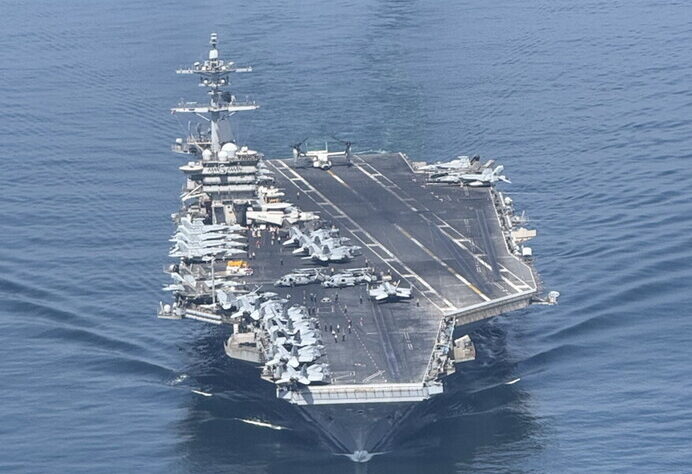
In a parallel move signalling increased pressure on Tehran, the United States has strengthened its military deployment in the region. Trump announced that the advanced aircraft carrier USS Gerald R. Ford, currently positioned in the Caribbean, will soon be redirected to the Middle East. The vessel is expected to operate alongside the already deployed USS Abraham Lincoln, enhancing the U.S. naval footprint in the area.
The President also shared an image of the carrier on his social media platform, underscoring Washington’s firm stance as negotiations over Iran’s nuclear activities continue. The renewed military presence is widely seen as a strategic signal aimed at compelling Tehran to reach a comprehensive nuclear agreement.
Trump’s remarks came shortly after his meeting at the White House with Israeli Prime Minister Benjamin Netanyahu. Following the talks, he indicated that diplomatic engagement with Iran would continue, but warned that failure to secure a satisfactory deal could result in tougher measures. The United States has insisted that Iran must halt uranium enrichment. At the same time, Israel has pressed for additional restrictions, including curbing Tehran’s ballistic missile program and its backing of regional armed groups.
Iranian President Masoud Pezeshkian has suggested that Tehran is willing to consider certain limits on its nuclear program in exchange for sanctions relief. At the same time, he emphasised that Iran would not give in to what he described as excessive external pressure.
It is noteworthy that during his first term, Trump withdrew the United States from the nuclear agreement negotiated under former President Barack Obama and reinstated sweeping economic sanctions on Iran. Those measures had a significant impact on Iran’s economy and strained bilateral relations.
With diplomatic efforts ongoing and military deployments intensifying, tensions between Washington and Tehran remain high, adding further uncertainty to the already volatile Middle East landscape.
Source: News Agencies