
By: The Trek News Desk
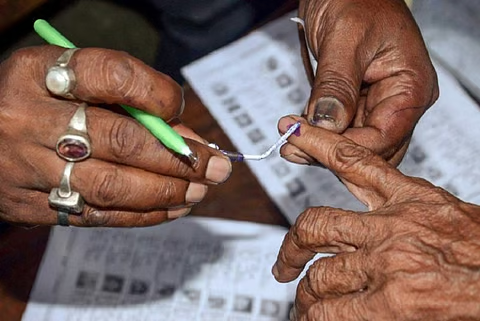
The Supreme Court on Thursday delivered a firm message to State governments, making it clear that the ongoing Special Intensive Revision (SIR) of electoral rolls cannot be disrupted due to the rising workload concerns of Booth Level Officers (BLOs). The Court said it is the State’s responsibility to address the distress of BLOs and ensure adequate manpower for the revision exercise.
States Free to Add Manpower or Substitute Staff
A Bench led by Chief Justice Surya Kant and Justice Joymalya Bagchi observed that States may either replace overstressed BLOs or strengthen the workforce by sending additional personnel. Since BLOs are State employees, the Bench noted, their statutory duties, including the distribution of enumeration forms, must be fulfilled on time.
Exemptions Allowed in Genuine Personal Hardship
The Court clarified that individual cases involving health issues or personal difficulties can be considered. States may, on a case-by-case basis, relieve such employees and assign replacements wherever necessary.
Election Commission Counters Claims of Excessive Pressure
Appearing for the Election Commission (EC), senior advocate Rakesh Dwivedi dismissed allegations of overwhelming workload, calling them “imagined concerns.” He pointed out that:
- Each polling booth is capped at 1,200 voters,
- BLOs have 37 days (November 4–December 11) to complete tasks,
- And States like Tamil Nadu and Uttar Pradesh have already distributed 85–90% of the forms.
Petitioners Say BLO Distress Is Real and Deep
Senior advocate Kapil Sibal, representing petitioners from Kerala and West Bengal, urged the Court to acknowledge the seriousness of BLOs’ working conditions.
“Why rush the SIR when the next Uttar Pradesh election is in 2027?” he asked, questioning the need for a two-month deadline. He further argued that the EC’s claims regarding form uploads and progress must be independently verified and not accepted blindly.
Concerns Over FIRs, Punitive Action, and Suicides
Senior advocate Gopal Sankaranarayanan, representing Tamilaga Vettri Kazhagam, informed the Court that many BLOs, largely drawn from anganwadi workers and primary school teachers, were being threatened with:
- Imprisonment,
- Disciplinary proceedings, and
- Loss of employment
if they failed to meet targets.
He stated that:
- 50 FIRs have been filed under Section 32 of the Representation of the People Act, 1950,
- And around 30 BLOs nationwide have taken their own lives.
He urged the Court to restrain the EC from filing criminal complaints, stressing that although BLOs are State employees, they perform duties on behalf of the EC, which must treat them sensitively.
Court Shifts Responsibility Back to the States
The Bench took a clear stance that BLOs fall strictly under State jurisdiction. Therefore, it is up to the States to decide whom to assign, whom to exempt, and how to ensure completion of SIR within the deadline.
Chief Justice Kant remarked, “The work cannot come to a halt. Someone has to carry it out. They are State employees with an obligation to perform. Just as officers travel across States to conduct elections, the SIR too must be completed on schedule.”
Source: News Agencies