
By: The Trek News Desk
Prime Minister Narendra Modi will not travel to Kuala Lumpur, Malaysia, for the upcoming ASEAN Summit scheduled for this weekend, official sources confirmed on Thursday.
Instead, External Affairs Minister S. Jaishankar will represent India at the high-level meeting.
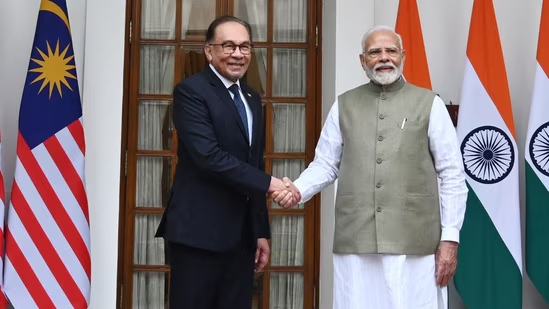
In a social media post, Prime Minister Modi announced that he will participate in the ASEAN-India Summit virtually, extending his greetings to the Malaysian leadership and reaffirming India’s commitment to strengthening ties with Southeast Asian nations.
Modi’s Virtual Participation, Jaishankar on Ground
PM Modi wrote:
“Had a warm conversation with my dear friend, Prime Minister Anwar Ibrahim of Malaysia. Congratulated him on Malaysia’s ASEAN Chairmanship and wished success for the upcoming summits. I look forward to joining the ASEAN-India Summit virtually and deepening our Comprehensive Strategic Partnership.”
While the Ministry of External Affairs (MEA) has not officially cited a reason for the cancellation, diplomatic sources suggest that Modi’s focus on the ongoing Bihar election campaign played a role in his decision to skip the visit.
Trump Among Key Attendees; Modi-Trump Meeting Off the Table
The Kuala Lumpur summit will host several global leaders, including U.S. President Donald Trump.
Observers had anticipated that the event might facilitate a face-to-face meeting between Modi and Trump, particularly at a time when India-U.S. relations remain strained over trade and energy issues.
President Trump recently imposed a 50% punitive tariff on India in response to New Delhi’s continued purchase of Russian crude oil.
The two leaders spoke over the phone on October 21 (Diwali Day), but the nature of the conversation was interpreted differently in Washington and New Delhi.
Trump told a group of Indian-American community leaders at the White House that their discussion focused on “trade, Russian oil, and no war with Pakistan,” while Indian officials maintained that Pakistan was not mentioned at all.
Diplomacy Continues, But Face-to-Face Engagement Elusive
Since Trump’s tariff decision earlier this year, both sides have maintained regular diplomatic communication, but an in-person meeting has yet to take place.
Earlier, President Trump had invited Prime Minister Modi to the Sharm el-Sheikh Peace Summit on the Gaza conflict. India, however, was represented there by Minister of State for External Affairs Kirti Vardhan Singh, not the Prime Minister himself.
Despite tensions, Modi has publicly appreciated Trump’s mediation efforts in the Israel-Palestine conflict, though analysts note that political optics and domestic priorities on both sides have complicated their interactions.
Sources in Washington say President Trump continues to claim that he “helped end the May 2025 India-Pakistan conflict”, a statement that New Delhi has neither confirmed nor endorsed, further adding to diplomatic unease.
Political and Strategic Undercurrents
Modi’s decision to skip the ASEAN Summit carries both domestic and geopolitical implications. Domestically, the Prime Minister’s attention is centred on the high-stakes Bihar elections, while internationally, India’s strategic balancing act between Washington and Moscow continues to test its foreign policy agility.
With Jaishankar leading the Indian delegation, all eyes will now be on how India positions itself on key ASEAN issues from regional connectivity to maritime security and whether Modi’s virtual participation can match the weight of his physical presence.
Source: News Agencies