

A groundbreaking new astronomical study has cast doubt on long-held assumptions about the size of supermassive black holes, suggesting they might be far smaller than previously estimated. This unexpected finding could potentially reshape the scientific understanding of how galaxies and the universe itself evolve.
According to a report by the Australian National University, The discovery came from the analysis of a quasar, an extremely bright and energetic core of a distant galaxy located over 12 billion light-years away from Earth. Despite the intense luminosity of the quasar, the black hole at its centre was found to have a mass equivalent to just one billion suns, nearly ten times smaller than earlier estimates for similar celestial objects.
Southampton-Led Team Makes Breakthrough
This surprising revelation comes from a team of international scientists led by the University of Southampton, in collaboration with researchers from several European countries. The team utilized cutting-edge instruments located at the European Southern Observatory (ESO) in Chile, including the high-precision Gravity+ tool, which combines data from four of the world’s largest telescopes.
Dr. Christian Wolf, an associate professor who co-led the study, explained in an interview with ANU Reporter:
“Despite the extreme brightness of the quasar, the black hole at its heart is much smaller than expected. It’s not aggressively feeding on surrounding matter; instead, it seems to be pushing gas outward, likely driven by its own blinding radiation.”
The black hole was originally identified in 2024 by Dr. Wolf and his colleagues at the Australian National University (ANU).
A Mystery Solved?
Professor Seb Hoenig of the University of Southampton, another lead scientist in the project, said the discovery might finally provide answers to a long-standing cosmic puzzle.
“We’ve always wondered how such massive black holes could form in the early universe. Given the age of some galaxies, they shouldn’t have had enough time to grow that large. This study offers a possible explanation,” he told the Press Association (PA).
Cosmic Radiation Slowing Growth
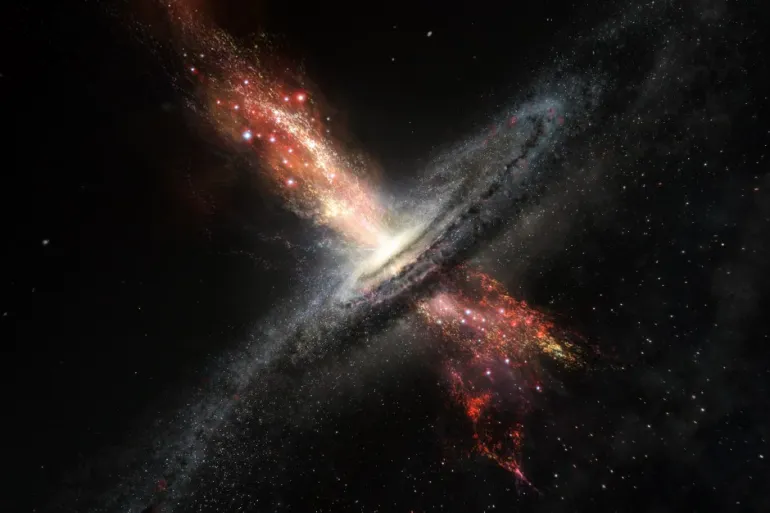
The Gravity+ data revealed that intense radiation from the quasar is acting like a “cosmic hairdryer,” forcefully blowing away the very gas the black hole would need to grow. This radiation-driven expulsion limits how quickly the black hole can accumulate mass.
Professor Hoenig elaborated:
“Imagine a black hole trying to eat, but every time food gets close, a powerful blast of energy blows it away. That’s essentially what we’re seeing.”
Rethinking Black Hole Physics
These findings could lead to a major re-evaluation of how scientists measure black holes and their impact on the development of galaxies in the early universe. The data suggest that radiation pressure, not just gravitational pull, plays a crucial role in regulating black hole growth, something not fully accounted for in current models.
Astronomers and astrophysicists are now expected to revisit existing theories of cosmic evolution, potentially updating simulations and observational methods used in studying deep space.
The study not only offers insight into how black holes form but may also help explain why early-universe galaxies seem to host such disproportionately large black holes. As more observations are made using advanced telescopes, scientists hope to unlock further mysteries of our cosmic origins.
Source: Australian National University