

By: Prerna Bharti
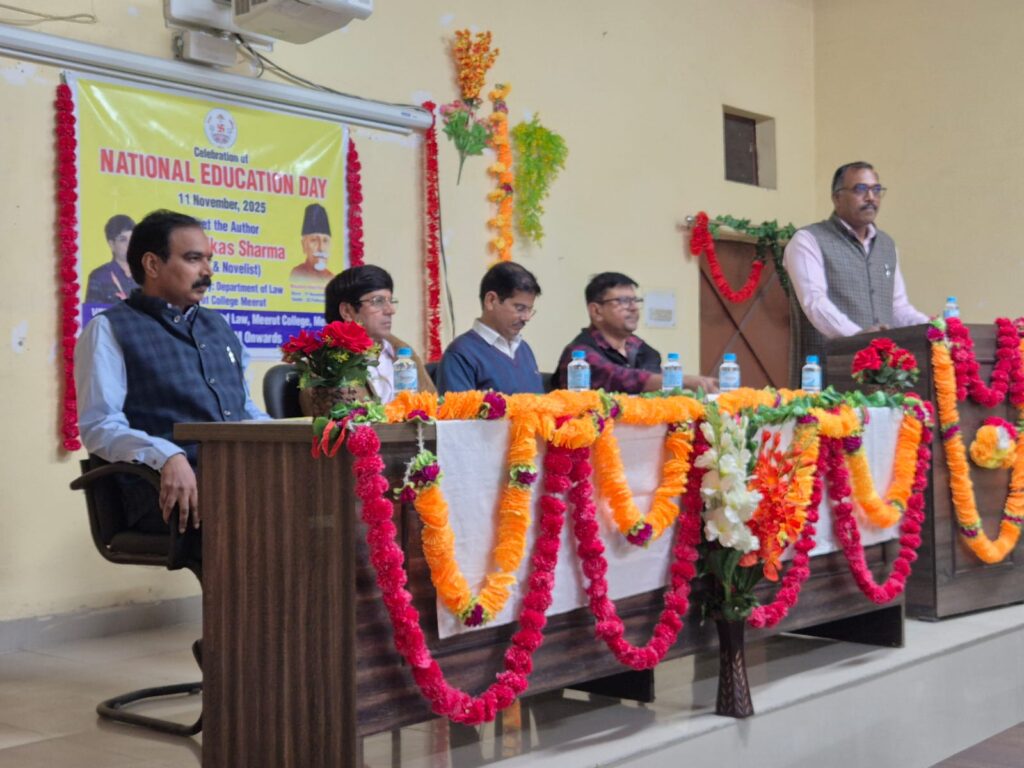
The Department of Law at Meerut College marked National Education Day on Tuesday with great enthusiasm and reverence, commemorating the birth anniversary of India’s first Education Minister and eminent scholar, Maulana Abul Kalam Azad. The event, held at noon in the department auditorium, celebrated Azad’s vision and lasting contributions to India’s modern education system.
Honouring a Legacy of Learning
The ceremony was graced by Prof. Vikas Sharma, a renowned poet, novelist, and academician, who attended as the chief guest. The event was presided over by Prof. Kameshwar Prasad Pandey, Head of the Law Faculty.
Among the distinguished attendees were Prof. Praveen Dublish, Prof. Harishankar Rai, Prof. M.P. Verma, Prof. Anurag Singh, Prof. Dwarika Prasad, Dr Ashok Sharma, Dr Jitendra Singh Yadav, Dr Suman Chauhan, Dr Seema Rani, and Dr Hitesh Kumar, along with other faculty members of the department.
The program commenced with a floral tribute to Maulana Abul Kalam Azad, led by Prof. Sharma, Prof. Pandey, and other faculty members, symbolising respect and remembrance of the great educationist’s ideals.
Speeches Reflecting on Azad’s Educational Vision
In his address, Prof. Kameshwar Prasad Pandey highlighted Azad’s pivotal role in shaping India’s secular and inclusive education system. He emphasised how Azad’s vision laid the groundwork for a modern, accessible, and progressive educational framework in post-independence India.
Prof. Praveen Dublish, speaking on the philosophical essence of Azad’s thoughts, remarked that “education remains the strongest tool for social transformation,” echoing the late leader’s lifelong commitment to knowledge and empowerment.
Chief Guest’s Insight: The Writer’s Struggle and Social Responsibility
Delivering the keynote address, Prof. Vikas Sharma engaged the audience with an insightful discussion on the challenges faced by writers in modern society. He noted that authors often battle social, psychological, and political pressures, struggles that remain largely unseen by the public.
Prof. Sharma shared reflections on his notable works, including his first Hindi novel Rāh ke Patthar, his English novel Love Is Not Time Fool, and other titles such as IAS Today, 498A, Honey Trap, Hall for People, and Coming Soon: A Media Regulation 2030. He drew connections between Maulana Azad’s educational ideals and the transformative power of literature in shaping public thought.
Concluding Remarks
The program was skilfully anchored by Dr Kaushal Pratap Singh, while Dr Ashok Sharma extended a heartfelt vote of thanks to all guests and participants.
The celebration concluded on a reflective note, reinforcing the message that education is not merely a system but a movement, one that Maulana Azad envisioned to awaken the conscience of a developing nation.
The event was widely regarded as a success, fostering renewed awareness about the values of education, intellectual freedom, and the enduring spirit of learning that Azad championed throughout his life.

