By: The Trek News Desk
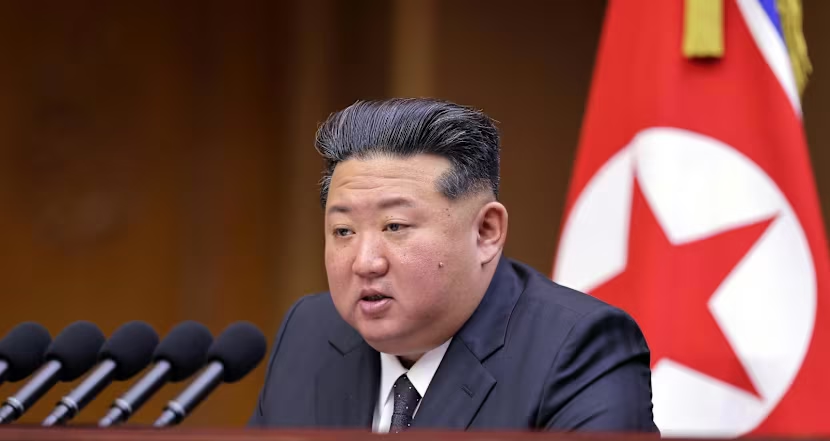
North Korean leader Kim Jong-Un has expressed a willingness to engage in dialogue with the United States, on the condition that Washington abandons its longstanding demand for nuclear disarmament. In a speech delivered on Sunday at the Supreme People’s Assembly in Pyongyang, Kim stated, “If the United States drops its insistence on our nuclear disarmament and demonstrates a genuine desire for peace and coexistence, we see no reason not to engage in talks with them.”
Kim’s comments came after a reflection on his past interactions with former U.S. President Donald Trump, with whom he held three summit meetings. Kim remarked that he had “good memories” of his relationship with Trump, calling the former president a “positive person.” In response, Trump expressed his desire for another meeting with Kim, claiming that he knows him “better than anyone, except Kim’s sister.”

Rhetoric from South Korea’s President: A Shift Toward Engagement
South Korean President Lee Jae-Myung, while supporting increased communication with North Korea, also revealed an unconventional suggestion: he would like to see a “Trump Tower” built in North Korea, ideally with a golf course included. However, the North’s strong reaction to U.S. and South Korean joint military exercises has been critical. Kim Jong-Un’s sister, Kim Yo-Jong, called these military drills “dangerous” and described them as preparations for a potential attack.
International Tensions: Diverging Approaches to North Korea’s Nuclear Program
In an exclusive interview with BBC and Reuters, President Lee Jae-Myung stated that South Korea is open to a “realistic” approach in dealing with North Korea’s nuclear weapons program. Rather than focusing solely on forcing North Korea to abandon its current nuclear stockpiles, Lee suggested that halting the production of new nuclear weapons could be a more attainable goal. He acknowledged that previous pressure-based strategies had been unsuccessful and that North Korea continues to produce between 15 and 20 new nuclear weapons each year.
“Conflict-oriented policies have not only failed but have worsened the situation,” Lee said in a candid admission about the ongoing impasse.
North Korea’s Resilience Amid Sanctions
Despite decades of international sanctions imposed by the United Nations due to North Korea’s nuclear and ballistic missile programs, Kim Jong-un remains steadfast in his stance. The North Korean leader stated that the sanctions had not harmed the country; rather, they had made it stronger and more resilient. Last year, Kim vowed to rapidly expand the country’s nuclear arsenal to counter what he described as “hostile forces.”
Rising Geopolitical Tensions: The Risk of a New Cold War
The latest developments in the North Korean situation have added to growing concerns about a potential new Cold War. According to a report by the Stockholm International Peace Research Institute (SIPRI), the world may be heading toward a new nuclear arms race, involving nine nuclear-armed nations: North Korea, China, Russia, the United States, Pakistan, India, France, the United Kingdom, and Israel. The prospect of U.S.-North Korea talks, prompted by Kim Jong-un’s recent statements, could place further strain on global security.

China and Russia’s Support for North Korea
Kim Jong-Un’s remarks come at a time when he has strengthened his political and military alliances with China and Russia. Earlier this month, Kim met with Chinese President Xi Jinping and Russian President Vladimir Putin in Beijing. The trip signalled North Korea’s growing partnership with the two major powers, which has raised concerns in Washington. In a social media post, Donald Trump criticized the interactions, suggesting that Xi Jinping should send his “best wishes” to Putin and Kim, as they are “plotting against America.”
A Complicated Path Forward
Kim’s statement, along with President Lee’s comments, indicates a potential window for dialogue between the U.S., South Korea, and North Korea. However, experts warn that the process of negotiations remains fraught with challenges, given the differing priorities and deep-rooted mistrust among the involved parties. As tensions mount in the region, the global community watches closely to see how these geopolitical dynamics unfold.
Source: News Agencies