
By: The Trek News Desk
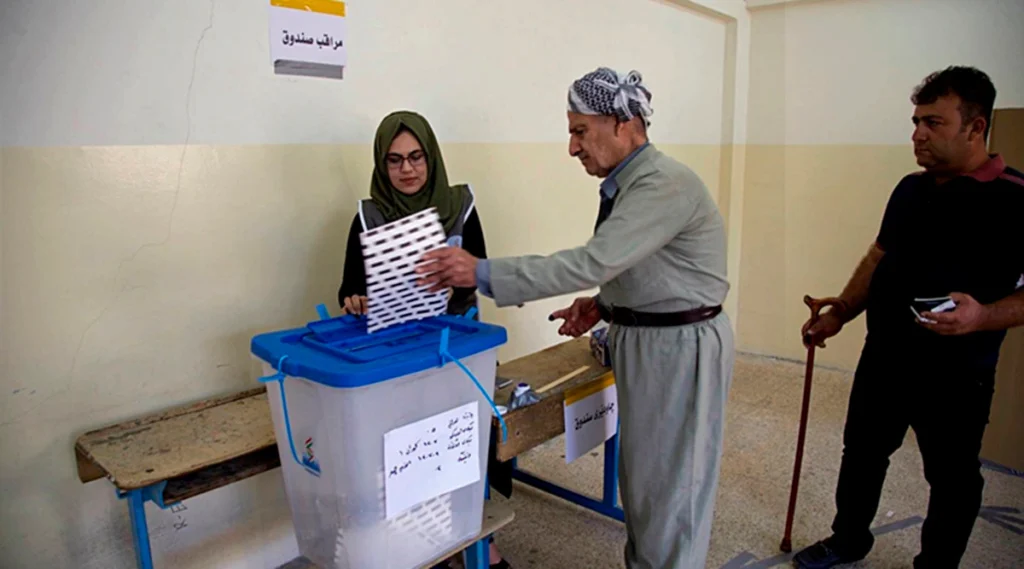
Iraqis began voting on Tuesday to elect a new parliament, a contest drawing intense attention from both the United States and Iran. The vote comes at a defining moment, as the war-scarred nation strives to move beyond years of conflict, dictatorship, and political turbulence toward long-term stability.
Between Hope and Disillusionment
Once plagued by war and repression, Iraq, home to around 46 million people, has enjoyed relative calm in recent years. Yet beneath the surface, the country continues to grapple with weak infrastructure, failing public services, and entrenched corruption that have eroded public trust.
Many Iraqis say they no longer believe elections can bring change.
“Every four years, the same faces return,” said Al-Hassan Yassin, a university student in Baghdad. “We never see young or fresh leaders who can actually make a difference.”
The Polls and the Candidates
Polling stations opened at 7 a.m. local time (04:00 GMT) and will close at 6 p.m. (15:00 GMT).
More than 7,740 candidates, nearly a third of them women, are competing for 329 seats in parliament.
Only 75 independents are contesting, as Iraq’s current electoral law is seen to favour larger political blocs.
Over 21 million voters are eligible, but observers fear turnout could fall below the 41% recorded in 2021, the lowest since Iraq began holding elections after the U.S.-led invasion.
Sectarian Politics Still Shape Power
Since the 2003 U.S.-led invasion that ousted Saddam Hussein, Shia parties have dominated Iraq’s political landscape.
By long-standing convention, the prime minister is Shia, the parliament speaker is Sunni, and the largely ceremonial presidency goes to a Kurd.
Prime Minister Mohammed Shia al-Sudani, who came to power in 2022 under the banner of stability and reconstruction, is seeking a second term.
He rose to prominence through the Coordination Framework, an alliance of Shia groups widely aligned with Iran.
Sudani has pointed to his record of keeping Iraq relatively stable amid escalating regional chaos. Yet, securing a parliamentary majority may not be enough; the next prime minister will depend on whichever coalition can forge the largest alliance after the vote.
The Absence of Moqtada al-Sadr
A defining feature of this election is the absence of influential Shia cleric Moqtada al-Sadr, who has called for a boycott, branding the process as “flawed and unjust.”
In the 2021 elections, Sadr’s movement had secured the largest bloc in parliament. However, after clashes with rival Shia factions over government formation, he withdrew his MPs, triggering violent confrontations in Baghdad.
His withdrawal leaves a major vacuum in Shia politics and could reshape post-election alliances.
Sunni and Kurdish Parties: Familiar Lines, Old Rivalries
Sunni parties are contesting separately, with former parliament speaker Mohammed al-Halbussi expected to perform strongly.
Meanwhile, in the semi-autonomous Kurdistan region, the long-standing rivalry between the Kurdistan Democratic Party (KDP) and the Patriotic Union of Kurdistan (PUK) remains as fierce as ever.
A Diplomatic Balancing Act: Between Washington and Tehran
For years, Iraq has sought to maintain a delicate balance between its two most powerful partners, the United States and Iran.
That balancing act is becoming even more fragile as the Middle East undergoes rapid geopolitical shifts, with old powers weakening and new alliances emerging.
Iran is determined to retain its influence in Baghdad, especially as its regional allies in Lebanon, Yemen, and Gaza have suffered heavy losses since 2023.
The United States, meanwhile, has been pushing Baghdad to curb the power of Iran-backed militias and prevent them from destabilising the region.
U.S. Special Envoy Mark Savaya recently declared that Washington’s goal is to “free Iraq from the malign influence of Iran and its proxies.”
The Road Ahead
For Iraq, this election represents more than a contest for power; it is a test of political sovereignty, regional balance, and the people’s fading faith in democracy.
While Washington and Tehran watch closely for signs of strategic advantage, ordinary Iraqis are left wondering if their votes can still make a difference or if this election will once again serve only the interests of the political elite.
Source: News Agencies