
By: The Trek News Desk
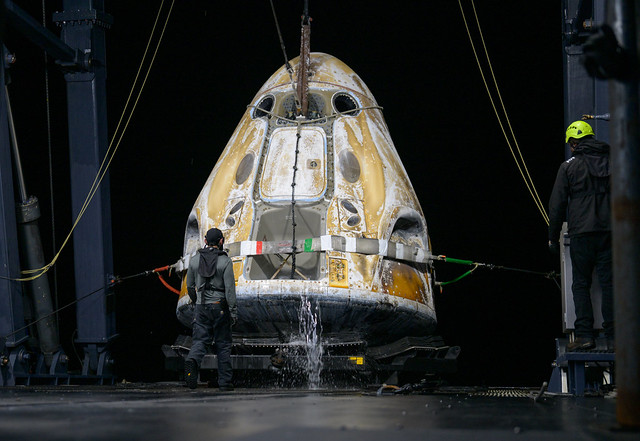
Four astronauts who were brought back early from the International Space Station (ISS) due to a medical emergency have safely returned to Earth following a successful splashdown in the ocean. The mission was cut short by nearly a month after NASA described the situation as involving a “serious” health concern.
Mission commander and NASA astronaut Mike Fincke was the first to exit the spacecraft. He appeared smiling but slightly unsteady, a normal effect after extended time in microgravity, and was placed on a stretcher as per standard recovery protocol. He was followed by NASA astronaut Zena Cardman, Japan’s Kimiya Yui, and Russian cosmonaut Oleg Platonov, who waved to cameras upon landing. “It feels great to be back home,” Cardman said.
First Medical Evacuation in ISS History
This marks the first time since the ISS was launched into orbit in 1998 that astronauts have been evacuated due to a medical issue. The team, known as Crew-11, will now undergo detailed medical evaluations before being transported to land-based facilities.
Speaking at a press conference after the splashdown, NASA Administrator Jared Isaacman said the affected astronaut is currently stable and in good spirits. In line with NASA policy, no further details regarding the individual’s identity or medical condition are expected to be made public.
Command Handed Over to Russian Crew
Following the early departure, operational control of the ISS has been transferred to Russian cosmonaut Sergey Kud-Sverchkov and two fellow crew members. The evacuated team had arrived at the station on August 1 and was originally scheduled to return in mid-February.
The situation came to light last week when a planned spacewalk was abruptly cancelled. Hours later, NASA confirmed that one crew member had fallen ill. During the handover ceremony, Fincke described the moment as “bittersweet” and later posted on social media that all astronauts remaining aboard the station are safe and well cared for.
Current Status of the ISS
Orbiting Earth at an altitude of roughly 250 miles, the ISS completes 16 orbits each day at a speed of about 17,500 miles per hour. Operated jointly by five international space agencies, the station serves as a hub for scientific research on how microgravity affects humans, animals, and plants.
While the ISS is equipped with basic medical supplies and astronauts are trained to handle minor health issues, there is no doctor stationed on board permanently.
Test of NASA’s Emergency Protocols
The incident has been seen as a major test of NASA’s emergency medical response procedures in space. Experts say the agency managed the situation effectively, though questions remain about how it might cope with a more severe medical emergency in orbit.
At present, the ISS is being maintained by a reduced crew of three, NASA astronaut Chris Williams and Russian cosmonauts Sergey Kud-Sverchkov and Sergey Mikaev, until a new four-member team arrives in February. Kud-Sverchkov said that despite the challenges, all scientific experiments and maintenance work will continue as planned, adding a light-hearted touch by ordering a group hug as his first command.
A Rare but Historic Moment
In the ISS’s 26-year history, this event is considered unprecedented. Only two space missions in the past have ended early due to health issues, one in 1985 aboard the Soviet Salyut-7 station and another in 1987 involving the Mir space station.
Source: News Agencies